Blog » Sweet Dews Of Dharma Talks » 2026 » The Inner Work of Repentance: Confess Wrongdoings, Cut off the Root of Offenses
The Inner Work of Repentance: Confess Wrongdoings, Cut off the Root of Offenses 2026-01-03
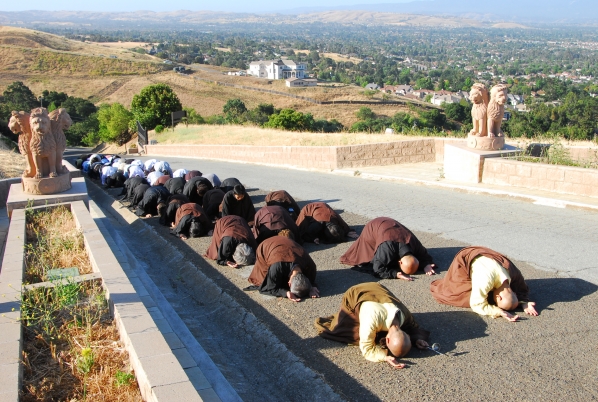
- Dharma Talk by Dharma Master Jin Gwo at the Emperor Liang Repentance Dharma Assembly, November 2025
Today, as we gather to bow repentance, I would like to share with you how repentance should be practiced, according to Great Master Ouyi of the Chinese Pure Land tradition. Master Ouyi mentioned ten methods of repentance; today I will briefly talk about the key points. In the Emperor Liang’s Repentance, it says that we commit offense all because of a lack of faith in the Triple Jewel. Therefore, all repentance must begin with taking refuge with and bowing respectfully to the Triple Jewel.
One crucial core of the repentance practice is this: Before bowing in repentance, you must confess your own faults and wrongdoings before the Buddha, openly stating your offenses. Without clearly articulating your own wrongdoings, there is no way you can cut off the root of your offenses, or the mind that perpetuates the continuity of offenses. It’s like weeds in a yard: if you try to remove them, you have to pull out the roots, otherwise, they will grow back again. But how to eliminate weeds completely? By pulling their roots out and exposing them in the sun until they are completely dried out and dead- if the karmic offenses wither, then they can no longer bear unwholesome fruit.
Therefore, before each repentance session, you should clearly state your offenses and wrongdoings before the Buddha. Each time you do so, it is like pulling out the roots of weeds and exposing them to sunlight, leaving them no chance to grow back. Of course, resting, or going to the restroom during the break is important, but more important is setting aside time to state your own wrongdoings before the Buddha.
Merely saying, “I forgot” or “I don’t remember clearly” does not make karmic offenses disappear. They do not vanish that way. If you don’t repent, they will keep growing-just like roots left intact underground. Whenever afflictions arise,they are like water nourishing those roots, causing them to grow deeper. So don’t be afraid of inconvenience– in the future, no matter what routine practices you are doing, or what Dharma ceremonies you are attending, remember to confess your wrongdoings before the Buddha. Each confession is like another exposure to sunlight. For example, you can begin from childhood, confessing wrongdoings such as deceiving your parents, stealing money, doing harmful things, cheating on exams, you should repent them all.
At the end of each roll of Emperor Liang’s Repentance, there is a praise which you probably are familiar with. Let me recite two lines of them: “Where the repentance text is recited, flowers of offenses fly away.” Have you ever wondered why the word “ flowers” is used here? These are not the flowers scattered by beautiful heavenly maids. When you reach the section of Revealing Fruits of Retribution, you will know what these “flowers” are.
That chapter contains many examples describing how living beings undergo different sufferings and why they receive those retributions. In one passage, it mentions that upon encountering Venerable Śāriputra, who had spiritual powers, many ghosts rushed to ask him: “Why am I suffering so much, what on earth did I do in my last life?” Venerable Śāriputra would explain what actions they did in the past led to their present suffering. But in the end, Venerable Śāriputra would say, “What you are undergoing now is called a “ flower retribution", your “fruit retribution” will be in hell.
From this passage, we can know that ghosts have ghosts’ flower retribution, and we human beings have human flower retribution, and various sufferings we experience in this life are our flower retribution. What is unique about the repentance practice is that the suffering you undergo now is the “flower” and you still have the chance to remove it, to pluck it out. If you don’t pluck it off, let me give another example, there are many weeds in your yard, right? Have you ever seen dandelions? When they bloom,and if you don’t pull them out, you lose the chance, as in the next year, your entire yard will be filled with dandelions. Likewise, regarding the flower retribution in this life, you should repent your karmic offenses when you still have the strength to bow in repentance, otherwise, if you don’t take the opportunity to remove them, then when fruit retributions ripen in the next life, the suffering will be beyond description.
That is why the verse of praise in the Emperor Liang’s Repentance says: “Where the repentance text is recited, flowers of offenses fly away.” You should repent every offense mentioned in the text as if they were your own offense. Repent in this way, sincerely and wholeheartedly. Only after your sincere repentance, can your offense flowers fly away. Therefore another praise follows: “Resentment is dissolved, offenses are repented, disasters are repelled, and blessings and wisdom increase.”
What I have shared today pertains to repentance through action. That is, you must personally engage in bowing and repenting yourself. Master Ouyi further taught that after you have committed wrongdoing, you must not repeat it, therefore you must hold precepts. By holding precepts, you prevent future offenses.

